Health
Home HIV Testing: How It Works and What to Know
Learn how home HIV testing works, when to test, how to read the result and when to seek confirmation from a healthcare professional.
Updated

On this page
Home HIV testing is a suitable option for those who want to proactively check their HIV status. This method is convenient, private, and can be performed at home. However, the results are only reliable when you use the correct test type and at the correct time. In addition, the method of sample collection is also very important. If the procedure is incorrect, the results may not be accurate.
In addition, users need to understand the window period. This is the time period from the risk to when the test can detect HIV. Therefore, self-testing is not simply buying a test kit and performing it. You need to understand how to use it, how to read the results, and when to visit a medical facility. The article below will help you understand Home HIV Testing better. At the same time, you will also know how to handle if the result is negative, reactive, or inconclusive.
What is Home HIV Testing?
Home HIV testing is a form of self-testing for HIV without the need for medical staff to perform the entire process. Depending on the product, users can collect oral fluid or a blood sample from the fingertip. Then, the sample is placed into the test kit according to the instructions.
Many self-HIV test kits work by detecting HIV antibodies. However, the body needs time to produce enough antibodies.
Therefore, testing too early may result in a negative result even if HIV has already entered the body. Therefore, before using, you should check the type of test and the window period of the product.
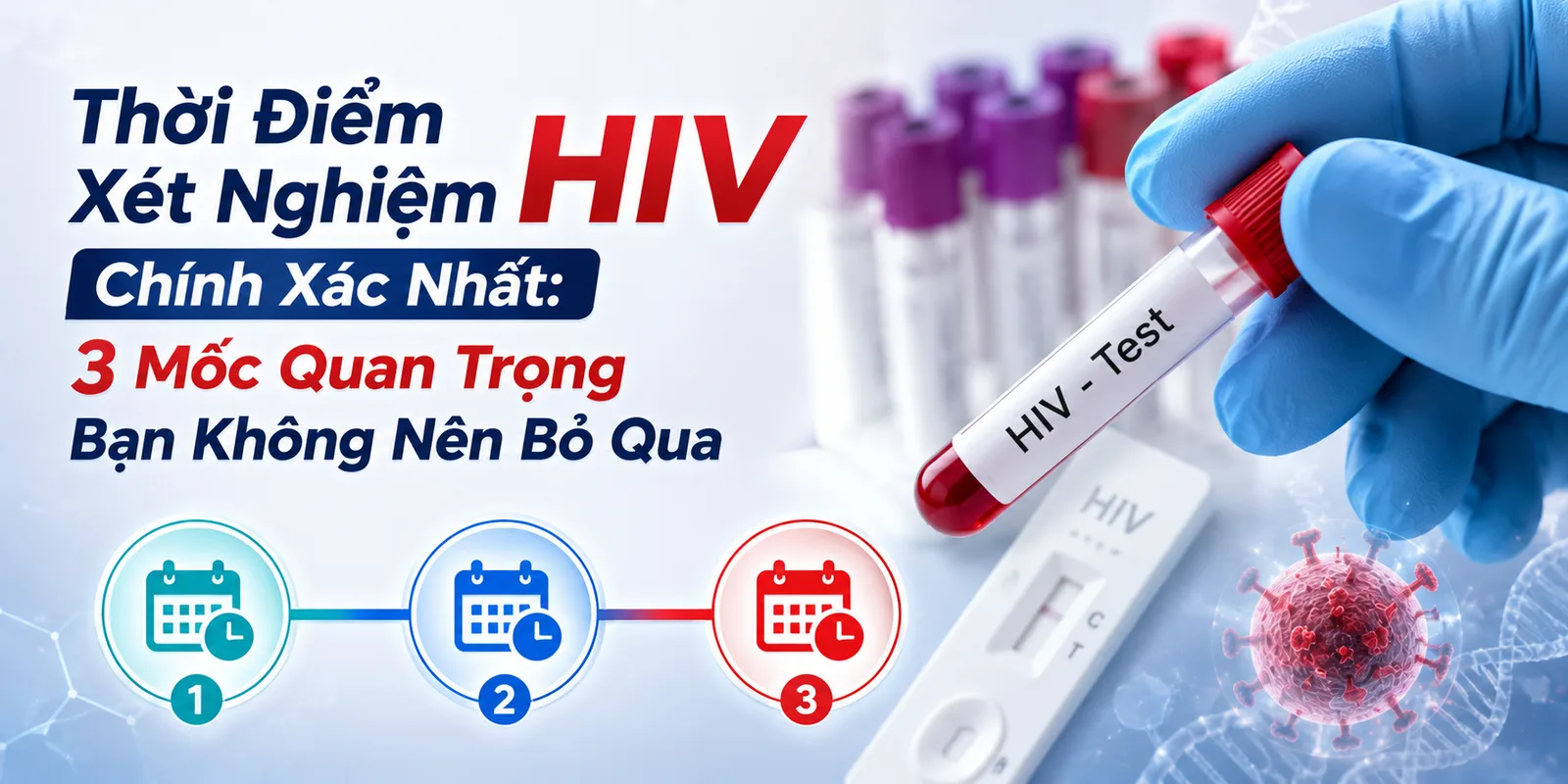
When should you perform Home HIV Testing after a risk?
The timing of the test greatly affects the reliability of the results. After HIV enters the body, the virus or related markers are not always detected immediately. This period is called the window period.
Each type of test has a different window period. Therefore, you should not apply a single time frame to all test kits. For example, some tests at medical facilities can detect HIV earlier than antibody-based self-test kits.
Therefore, you should read the product instructions carefully. If you are unsure, consult a medical staff before concluding from a negative result.
What should you prepare before self-testing for HIV?
Before starting, you should carefully check the test kit. This helps to minimize errors during the process.
- Check the origin and product information.
- Check the expiration date of the test kit.
- Check if the packaging is torn or damaged.
- Read the entire instructions before collecting the sample.
- Determine the type of sample needed.
- Prepare a clean, dry, and well-lit area.
- Prepare a clock to time the process.
- Do not share blood collection tools.
- Do not reuse needles.
- Check the window period of the test type.
In addition, you should prepare the information of the nearest medical facility. This way, you can contact them immediately if the result is reactive or inconclusive.
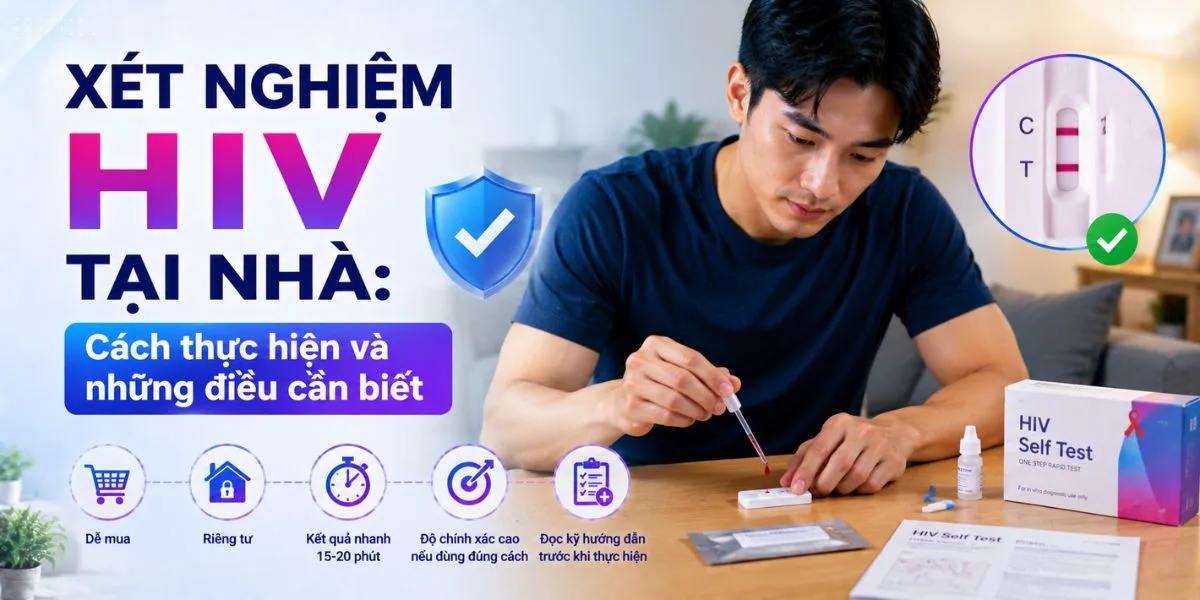
How to correctly perform Home HIV Testing
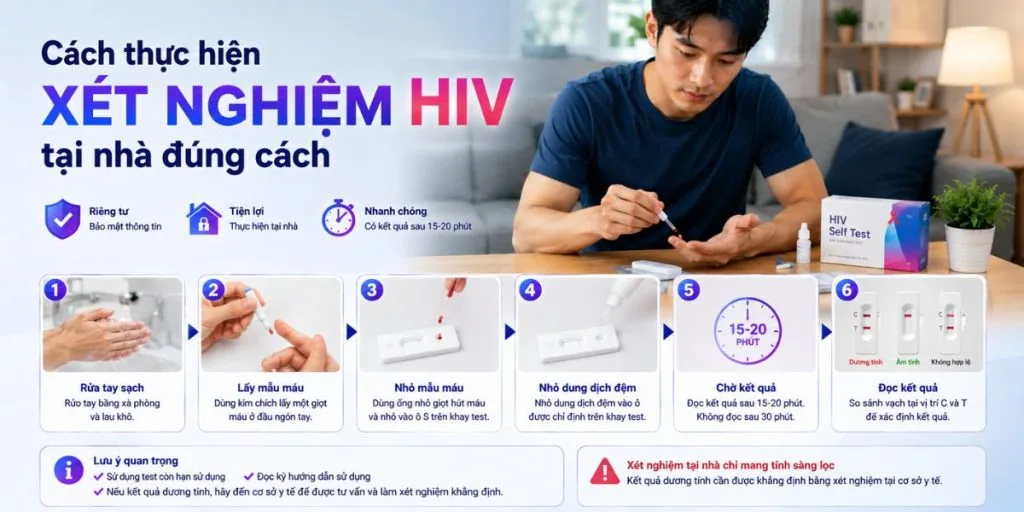
The method depends on the type of test kit. Therefore, the manufacturer's instructions should always be the primary source. For kits using oral fluid, you usually need to collect the sample from the gum area. Then, the device is placed into the test solution according to the instructions.
Meanwhile, kits using a fingertip blood sample require a small amount of blood. Users usually have to prick their fingertip with the included tool. After collecting the sample, follow the instructions carefully. At the same time, wait the required time before reading the results.
Especially, do not read the results too early or too late. Results outside the specified time frame may no longer be reliable.
Comparison between Home HIV Testing and Medical Facility Testing
| Criteria | Home HIV Testing | Medical Facility Testing |
|---|---|---|
| Location | Performed at home | Hospital or clinic |
| Level of privacy | High | Secure process |
| Sample collector | User self-collects | Medical staff |
| Type of sample | Oral fluid or blood depending on the product | Usually more options available |
| Result reading | User reads independently | Professional staff |
| Risk of incorrect procedure | Possible | Usually lower |
| Window period | Depends on test type | Depends on method |
| Reactive result | Needs confirmation | Has confirmation process |
| Direct consultation | Limited | Professional support available |
| Convenience | High | Requires visiting a medical facility |
In general, Home HIV Testing is suitable for those who need privacy and convenience.
However, medical facility testing has the advantage of professional expertise. In addition, users can receive additional advice about HIV and sexually transmitted infections.
Does a negative result mean you are definitely not infected with HIV?
Not all negative results have the same meaning. If the test is performed too early, HIV may not yet be detected. Therefore, a negative result during the window period cannot completely rule out infection.
Conversely, if you test after the appropriate window period, the negative result will be more reliable. However, the condition is that you have no new risk after the previous exposure. Therefore, when reading the results, always consider both the testing time and the test kit being used.
What should you do if your Home HIV Test result is reactive?
A reactive result does not mean a final HIV diagnosis.
Self-test kits mainly serve as a screening tool. Therefore, if the result is reactive, you need to visit a medical facility for confirmation testing.
- Do not panic upon seeing a reactive result.
- Check the time of result reading again.
- Do not self-conclude that you are infected with HIV.
- Contact a hospital or clinic.
- Perform confirmation testing as instructed.
- Do not self-purchase ARV drugs for use.
- Limit risky behaviors while waiting for confirmation.
- Discuss with medical staff if you feel anxious.
If the confirmation result is positive, current HIV treatment is highly effective. Starting treatment early helps control the virus and protect long-term health.
How does the window period affect the results?
The window period is a very important factor when Home HIV Testing. In the early stages after infection, the markers the test looks for may not yet be present in sufficient quantity. Therefore, even if HIV has entered the body, the test may not yet detect it.
In addition, each testing technology looks for different markers. Therefore, the window period varies between test types. Therefore, you should not rely solely on the number of days mentioned online. Check the official instructions of the test you are using.
Is Home HIV Testing accurate?
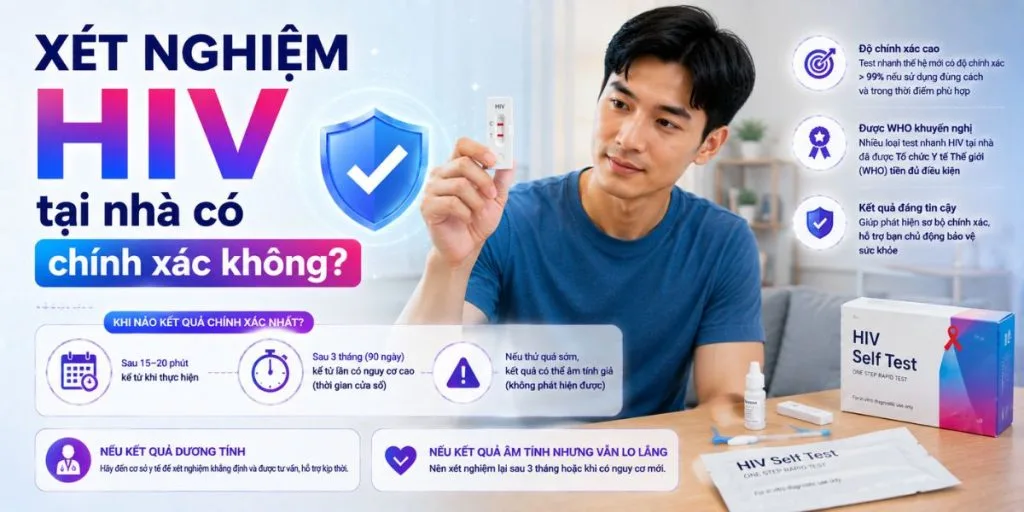
Approved self-test kits can provide high accuracy if used correctly. However, accuracy also depends on the testing time. If performed too early, the likelihood of missing HIV is higher.
In addition, the sample collection method is also very important. Insufficient sample or incorrect steps may affect the results. Storage conditions should also be considered. Inappropriate temperature or humidity may reduce the quality of the test kit.
Therefore, choose a product with a clear origin and follow the instructions from start to finish.
Common mistakes when self-testing for HIV
A common mistake is testing only a few days after exposure and believing the negative result is absolute.
In addition, some people use expired or unclear origin test kits. This may reduce reliability.
Another error is reading the results after the specified time. At that time, late appearance of lines may cause confusion.
In addition, users sometimes collect insufficient samples or touch the sample area incorrectly.
Therefore, perform each step slowly and accurately. If the result is unclear, use the official instructions or visit a medical facility.
When should you not rely solely on Home HIV Testing?
Self-testing is very useful. However, not every situation should rely solely on home test kits. If the risk occurred within 72 hours, you should contact a medical facility immediately. In appropriate cases, PEP may be considered. In addition, if you have unusual symptoms or high risk, you may need more specialized testing.
Self-HIV testing does not detect other STIs. Therefore, those at risk for syphilis, gonorrhea, or chlamydia may need additional checks. Therefore, Home HIV Testing should be considered an auxiliary tool. It does not completely replace medical services.
Who should consider regular HIV testing?
You do not need to wait for symptoms to test for HIV.
In fact, HIV may not show clear symptoms for a long time. Therefore, risk-based testing is often more useful. Those with new or multiple partners may consider regular testing.
Similarly, those who have had unprotected sexual relations should assess their risk. In addition, if you have been diagnosed with other STIs, you may discuss HIV testing with medical staff.
Why is early HIV testing important?

Knowing your HIV status early helps you make appropriate health decisions.
If the result is negative, you can consider future prevention measures. For example, PrEP may be suitable for some people with regular risk. If the result is confirmed positive, ARV treatment can be started according to professional guidance.
Early treatment helps control the viral load. At the same time, it helps maintain the immune system and reduce the risk of complications. In addition, when people living with HIV receive effective treatment and achieve an undetectable viral load, they can achieve U=U according to professional standards.
Home HIV Testing offers convenience and privacy. It is a suitable choice for many who want to proactively check their HIV status. However, the timing of the test is very important. If tested during the window period, a negative result may not be sufficient to rule out HIV.
Further reading
This article provides general information. For decisions about diagnosis, medicines or treatment, consult a qualified healthcare professional. Service availability and costs can change; confirm with the provider before booking. Our editorial approach
Published by Love2Test — Accessible sexual health information